

Contents
In the rush to adopt Artificial Intelligence, organizations find themselves awash in pilot projects, proof-of-concepts, and dashboards full of exciting activity metrics—but with little clarity on what actually moves the business forward. As AI initiatives transition from experimentation to production use, the most strategic leaders ask one question above all others: Is this investment delivering real, measurable value?
To answer that, organizations must shift from counting “cool demos” or usage spikes to measuring ROI in business terms—like hours saved, costs reduced, revenue increased, and capacity unlocked. Without a disciplined framework, companies risk scaling the wrong use cases or overestimating the impact of AI, eroding executive confidence and slowing broader adoption.
This article answers the question “how do you measure AI effectiveness” by unpacking a pragmatic approach to assessing AI effectiveness and grounding AI investment decisions in metrics that matter to the business.
ROI Foundations: Key Factors to Consider
Strong AI ROI doesn’t begin with impressive results—it begins with clarity. The most reliable ROI models start by defining a clear baseline: what work is happening today, how long it takes, how often it occurs, and who is responsible for it.
Once that foundation is set, AI impact becomes far easier to quantify when applied to repeatable workflows—tasks that are frequent, measurable, and consistently performed across teams. From there, defensible ROI depends on keeping inputs simple and consistent, typically focusing on people impacted, time per task, task frequency, and expected efficiency gain.
This disciplined approach to measurement is what allows organizations to move AI from isolated pilots to scalable deployment, giving leaders a clear way to prioritize what works, eliminate what doesn’t, and tie AI investment to both productivity gains and revenue-driving outcomes.
The ROI metrics executives care about most include:
- Net ROI (the clearest executive metric)
A true bottom-line view of impact, calculated by subtracting total solution costs from total value created—showing the real financial result. - Efficiency gains
Measured as a percent reduction in effort or cycle time, replacing vague claims like “AI makes us faster” with quantifiable improvement. - Time saved (or capacity gained)
Framing hours saved as capacity unlocked makes the value easier to understand and more actionable at the organizational level. - ROI %
A useful comparison metric, but one that’s highly sensitive to licensing, implementation effort, and ongoing costs—making transparency in inputs essential.
Calculating AI ROI in Practice
At LouderAI, we’ve seen how quickly AI momentum can stall when measurement lacks rigor. Inconsistent or overly optimistic ROI estimates erode executive confidence and make it harder to scale what’s actually working. That’s why our consultants built an internal tool specifically to estimate ROI before large-scale deployment—giving leaders a clear, defensible view of what measurable outcomes they should reasonably expect. The goal isn’t precision theater or inflated promises; it’s clarity. A credible baseline changes the conversation from “Is this interesting?” to “Is this worth scaling?”
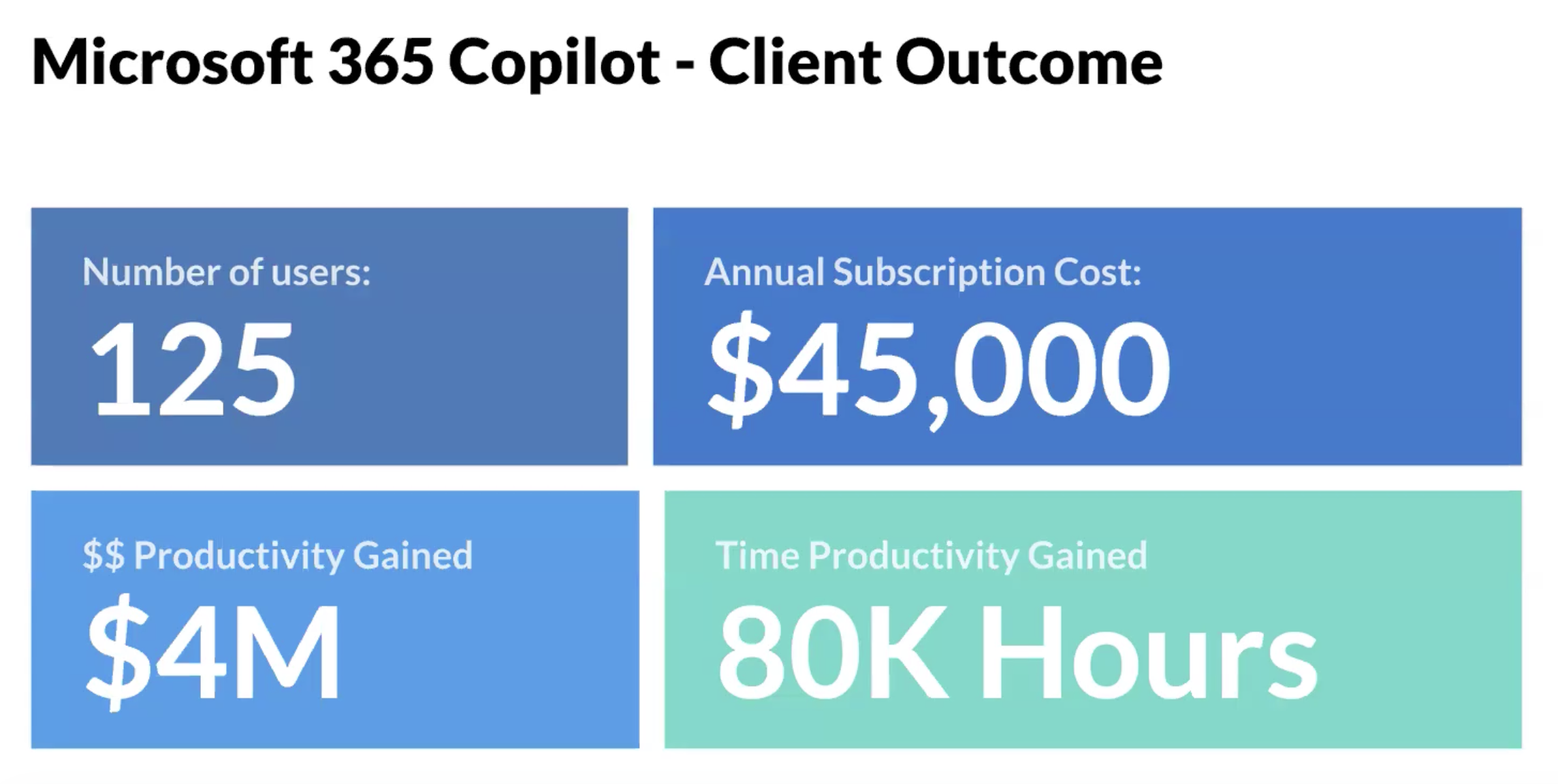
While many variables influence results, the core calculation is intentionally simple and transparent. We estimate annual ROI by measuring hours saved across a defined workflow, converting those hours into dollar value using role-based hourly rates, and subtracting the full annual cost of the solution—including licensing, implementation, and ongoing support—to arrive at net ROI and ROI%. By keeping assumptions explicit and consistent, this approach avoids hype, creates a shared measurement language across initiatives, and grounds AI decisions in financial reality—so leaders can prioritize confidently and scale with discipline.
Signs Your AI is Producing Real ROI
Not all AI progress translates into business value. The difference between visible momentum and measurable ROI becomes clear when leaders move beyond adoption metrics and start asking tougher questions: Does the time efficiency gained actually exceed the cost of the software and the resources required for adoption? Are improvements showing up consistently across teams, or only in isolated pockets?
When AI is truly working, its impact can be seen in concrete answers to these questions—reflected in faster workflows, increased capacity, and a cost-to-value equation leadership can compare across initiatives. Below are additional signals that your AI is producing ‘real ROI’, not just activity.
-
Material hours are returned to the business
Time savings are tangible, recurring, and large enough to change how teams operate—not just impressive one-off demonstrations. -
Usage is repeatable across users
Value isn’t dependent on a single power user or champion; the AI is embedded into everyday workflows across roles. -
Workflow cycle-time is measurably reduced
Critical processes move faster in observable, trackable ways, improving speed without sacrificing quality. -
Work volume improves without increased headcount
Teams handle more work or deliver faster outcomes using the same resources, signaling true productivity gain. -
The cost-to-value ratio is clear and comparable across initiatives
ROI is explicit and defensible, enabling executives to prioritize, scale, or sunset AI efforts with confidence.
Next Steps for Leaders: Turning AI Into a Measured Advantage
For many organizations, the challenge isn’t believing in AI’s potential—it’s knowing how to capture ROI in a reliable, repeatable way. Early on, leading AI initiatives or measuring impact can feel manageable, even straightforward. But as efforts expand, subtle red flags begin to surface, signaling the limits of what an organization can achieve on its own. Left unchecked, DIY approaches often result in fragmented pilots, unclear outcomes, and unnecessary loss of time and money.
LouderAI partners with enterprise and mid-market leaders to turn AI investment into measurable business outcomes—not just flashy activity or loose experimentation. We’ve helped many organizations establish clear ROI frameworks, prioritize the right use cases, and scale what works with confidence.
If you’re ready to move make AI accountable to real financial results, take our AI Readiness Assessment or schedule a no-pressure intro call to get started!

About the author: Andrew is the Founder & CEO of LouderAI, a Dallas-based consultancy dedicated to helping organizations unlock their full potential through cutting-edge AI solutions.
With nearly two decades in management consulting and a track record advising Fortune 500 clients, he’s earned recognition as a Dallas Business Journal 40 Under 40 honoree and Vistage Top Speaker.