

Contents
In a world where every brand chases the next shiny tool or tactic, it’s easy for marketing teams to confuse activity with impact. What separates the companies that win with AI from those that flail isn’t the volume of machine learning models they deploy or the flashy dashboards they build — it’s a coherent strategy that aligns AI with real business outcomes. AI strategy consulting is the bridge between aspiration and achievement, helping teams transcend guesswork and unlock sustainable growth.
For many leaders, AI marketing evokes images of automated ad copy generators or chatbots churning out content. But that’s only the beginning. When guided by a visionary yet practical strategic partner, AI becomes a catalyst for smarter decisions, sharper audience engagement, and measurable expansion — particularly for organizations with limited internal resources. This is especially true for AI marketing for small business, where every investment must justify itself in revenue, efficiency, or customer experience. And emerging technologies such as agenticAI for marketing are redefining what’s possible, from self-directed campaign optimization to autonomous audience segmentation.
In this article we’ll unpack how AI strategy consulting reinvents marketing by turning experimentation into strategic advantage, helping businesses chart a growth path that’s both ambitious and achievable.
AI Consultants Develop Intentional Strategies
In many organizations, AI marketing efforts begin with enthusiasm—and quickly drift into frustration. Teams pilot tools in isolation, test disconnected use cases, or assign AI “ownership” as a side responsibility rather than a true leadership role. Without clear direction or a dedicated lead, experimentation turns into noise. Budgets get spread thin, results are hard to attribute, and confidence in AI erodes before real value has a chance to materialize.
This is where AI strategy consulting fundamentally changes the trajectory. Instead of asking, “Which tool should we buy?” consultants reframe the conversation around intent. What specific growth constraint are we trying to remove? Where does AI create leverage that humans alone cannot? And how will success be measured in business—not technical—terms?
Effective consultants work alongside marketing teams and agencies to bring structure and accountability to AI adoption by:
-
Establishing clear, outcome-driven objectives, such as improving customer lifetime value, accelerating pipeline velocity, or lowering acquisition costs.
-
Translating those objectives into high-impact, realistic use cases—not experiments for experimentation’s sake, but initiatives with defined ROI metrics
-
Sequencing initiatives based on data feasibility, AI readiness, and strategic importance, so teams aren’t overwhelmed or chasing marginal gains.
This intentional approach prevents wasted spend and organizational fatigue. AI stops being a collection of disconnected tools and becomes a coordinated system that compounds value over time. A campaign optimization model, for example, matters not because it’s sophisticated, but because it consistently improves Return on Ad Spend, informs budget allocation, and frees marketers to focus on strategy rather than guesswork.
AI Consultants Identify Use Cases for Growth
The difference between AI that sounds impressive and AI that moves revenue comes down to use-case discipline. An effective AI strategy consulting engagement doesn’t flood marketing teams with possibilities—it builds a focused, prioritized roadmap grounded in business reality.
For AI marketing for small business, that focus is critical. Limited headcount and budget mean there’s no margin for unfocused experimentation. High-performing consultants zero in on use cases where AI replaces guesswork, compresses time-to-insight, and creates leverage that manual processes simply can’t.
Here are several high-impact ways AI is meaningfully leveling up modern marketing today.
-
Predictive Segmentation & Personalization
Rather than treating audiences as static personas, AI models analyze behavioral signals—purchase patterns, content engagement, lifecycle stage—to surface micro-segments that evolve in real time. Messaging becomes more relevant, timing improves, and campaigns feel less generic without increasing workload.
AI Tools: HubSpot AI & Salesforce Einstein -
Content Performance Forecasting
Instead of relying on intuition to decide what to publish, AI models can predict which topics, formats, and channels are most likely to perform—before content is created. This helps teams allocate creative resources more intelligently and reduce wasted production effort. Key components and methods include SEO traffic forecasting, content scoring and data sources.
AI Tools: Semrush & MarketMuse - Dynamic Attribution & Budget Optimization
AI-powered attribution models analyze thousands of cross-channel interactions—ads, email, search, social—to identify which touchpoints actually influence conversion.This enables marketing leaders to reallocate spend toward what’s driving revenue, not just visibility.
AI Tools: Google Analytics 4 & Dreamdata
Crucially, these aren’t hypothetical exercises. They’re defined, measurable initiatives that tie back to KPIs like conversion rate, average order value, and customer acquisition cost. The role of strategy consulting is to ensure these initiatives fit the business, its data maturity, and its growth ambitions — rather than being generic AI experiments.
AI Consultants Lead Practical Implementation, Adoption, and ROI Measurement
Vision without execution is just fantasy. One of the biggest value drivers of AI strategy consulting is guiding organizations through practical implementation — taking pilots and turning them into scalable, embedded capabilities.
A robust consulting engagement typically includes:
-
Data Readiness Assessment: Evaluating whether data infrastructure, governance, and quality are sufficient to support reliable AI models.
- Cross-Functional Alignment: Ensuring marketing, analytics, IT, and leadership share a common understanding of objectives, roles, and success metrics.
- Change Management: Helping teams integrate AI into workflows and mindset, rather than treating new capabilities as bolt-on experiments
- Performance Measurement: Defining clear, transparent metrics and dashboards to monitor impact and iterate quickly.
For small and mid-market teams, this guidance is especially valuable. Lean teams often lack dedicated AI practitioners, and attempting to develop and deploy models without support can lead to confusion, wasted spend, and lost momentum. A consulting partner brings expertise, structure, and accountability — while still keeping the process friendly and accessible.
AI Agents for Marketing
Looking forward, the evolution of AI in marketing isn’t just about better predictions — it’s about autonomy. AI marketing agents are purpose-built, autonomous software capabilities designed to plan, orchestrate, and execute marketing work end to end. They combine enterprise and campaign data with configurable business rules and model-driven reasoning to take action—not just report on performance—and they can improve over time as they learn from outcomes.
Unlike conventional AI that’s typically limited to analytics, forecasting, or content generation, agentic AI for marketing is action-oriented.It evaluates context, selects the next best step, and carries out tasks aligned to defined objectives. In practice, marketing agents can help teams:
- Engage customers via sophisticated conversational experiences and self-serve journeys
- Deliver 1:1 personalization, including tailored content and product recommendations
- Monitor, manage, and optimize campaigns continuously based on real-time signals
- Automate multi-step workflows across teams (e.g., marketing, sales, and customer success
AI agents mark a meaningful next step in marketing’s evolution—shifting teams from reactive analysis to proactive, always-on execution. To implement them successfully, organizations need clear governance and strong guardrails, backed by a deep layer of company-specific context (data, brand standards, and operating rules). This isn’t an “AI day one”initiative; it’s a strategic capability to deploy once your team has built AI fluency and is ready to operationalize agents as accountable, performance-driven extensions of the marketing function.
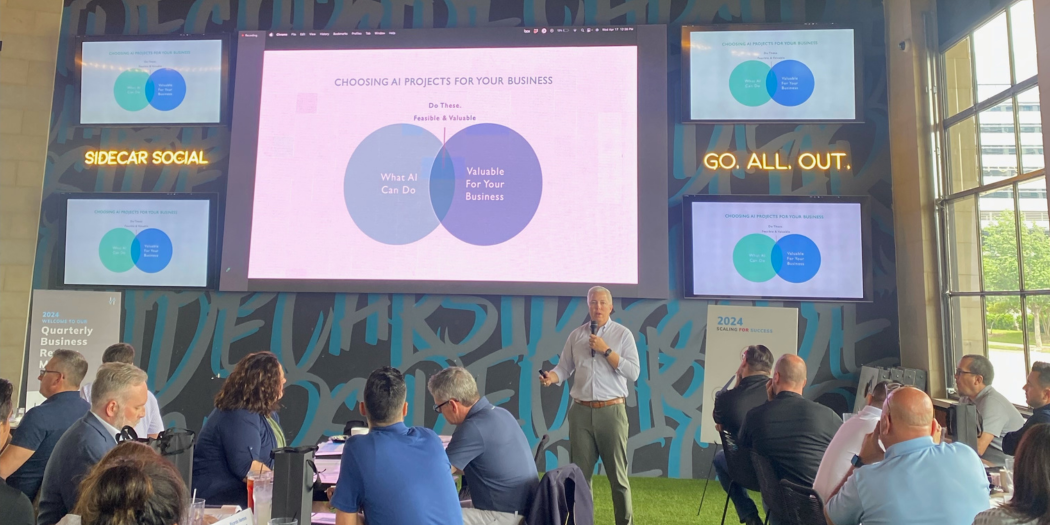
AI doesn’t drive growth on its own—strategy does. When marketing teams experiment without clear direction or ownership, AI quickly becomes fragmented, underutilized, and difficult to measure. Real impact comes when AI is intentionally aligned to business goals, prioritized use cases, and performance metrics that matter.
That’s where AI strategy consulting makes the difference. LouderAI helps mid-market and enterprise teams move beyond experimentation to build AI-powered marketing systems that deliver consistent, measurable results.
If you’re ready to turn AI into a true growth engine—not just another toolset—book a conversation with founder Andrew Louder to explore what an intentional AI strategy could unlock for your business:

About the author: Andrew is the Founder & CEO of LouderAI, a Dallas-based consultancy dedicated to helping organizations unlock their full potential through cutting-edge AI solutions.
With nearly two decades in management consulting and a track record advising Fortune 500 clients, he’s earned recognition as a Dallas Business Journal 40 Under 40 honoree and Vistage Top Speaker.