

.png)
Contents
For most of business history, the biggest companies held the advantage. They could afford more people, more systems, and more specialized talent than anyone else. Middle-market firms have always lived in the tension between the two—complex enough to need real infrastructure, lean enough that every inefficient process shows up directly in margin. That equation is changing.
AI agents are giving middle-market companies access to capabilities that were once reserved for enterprises with deep budgets and dedicated technology teams. Instead of simply answering questions, these agents can carry out multi-step work: pulling information from different systems, making decisions within defined guardrails, and completing tasks with minimal supervision. For a growing organization, that is the difference between adding headcount to keep up and getting far more value from the team you already have.
The gap between knowing and doing is striking. In LouderAI's AI Readiness Assessment, completed by leaders across our Vistage sessions, 87% said AI is critical to their future competitiveness—yet only 4% have defined an AI strategy, just 11% have trained their people to use it, and only 20% have a documented AI policy. Nearly every leader believes AI matters. Very few have built the foundation to act on it. That gap is exactly where early movers separate themselves—and it widens every quarter the rest wait.
In this article, we'll explore what AI agents for the middle market actually are, where they create the most value across everyday operations, and why the companies moving now are building an advantage that becomes harder to catch each quarter.
What Are AI Agents for Middle-Market Businesses?
An AI agent is software that can understand a goal, plan the steps to reach it, and take action across tools and systems—checking its own work along the way. Unlike a basic chatbot that responds one prompt at a time, an agent can complete a full task from start to finish, such as sorting incoming customer requests, drafting responses, updating a record, and flagging the exceptions that need a human.
For middle-market companies, this distinction matters more than the technology itself. The largest enterprises have entire departments built to absorb repetitive work. Middle-market teams rarely have that slack—the same people carrying strategic work are often the ones stuck on manual, repetitive tasks. When an agent takes that work off their plate, the organization reclaims the resource it can never buy back: the attention and judgment of its best people.
The good news is that adopting AI agents rarely requires rebuilding your operations. The strongest early wins usually come from applying agents to work you already do—inside the tools you already use—rather than launching a complex, ground-up transformation.
Before deploying an AI agent, it helps to evaluate where it will create the most value:
- Repetitive, rules-based work. Look for tasks your team does the same way, over and over—data entry, scheduling, order status updates, routine follow-ups.
- Clear inputs and outcomes. Agents perform best when the task has a defined starting point and a recognizable "done." Documenting the process first almost always improves the result.
- Available, organized information. An agent is only as good as the data it can reach. Prioritize work where the necessary information already lives in accessible systems.
- Meaningful business impact. Start where automation will save real hours, reduce errors, or noticeably improve the customer experience—not where it simply looks impressive.
Matching the right agent to the right task is what separates middle-market companies that see measurable returns from those that experiment for a few weeks and quietly move on.
.png?width=667&height=169&name=louderai-what-makes-an-agent-different%20(1).png)
In What Ways Can AI Help Middle-Market Companies Automate Their Operations?
The most valuable AI agents for the middle market are not the flashiest ones—they are the ones quietly removing friction from daily operations. Across the functions that stretch a lean team thinnest, agents are proving their value fast.
Customer Service
In a growing organization, responsiveness is often what sets the brand apart. AI agents help teams keep up without adding headcount by:
- Answering common questions instantly, around the clock—order status, hours, policies, and appointment scheduling
- Routing complex or sensitive issues to the right person with full context attached
- Drafting reply suggestions so a lean team can respond faster and more consistently
- Handling routine inquiries end to end, freeing staff to focus on the conversations that actually require a human
Across many middle-market operations, AI-powered support can resolve a large share of routine inquiries without any human involvement—turning a bottleneck into a competitive strength.
Sales and Marketing
Middle-market marketing teams are often lean relative to their goals, which makes automation especially valuable. Agents can:
- Draft and personalize outreach, follow-ups, and email campaigns
- Capture and organize lead information so nothing slips through the cracks
- Surface which prospects are most engaged and worth prioritizing
- Generate first drafts of content—social posts, newsletters, landing page copy—that a person then refines
Finance and Administration
The back-office work that keeps a business running is exactly the work that quietly consumes finance and administrative teams. AI agents can:
- Process and categorize invoices and expenses
- Flag duplicate charges, unusual transactions, or overdue payments
- Assemble recurring reports and summaries automatically
- Reconcile records across systems that don't naturally talk to each other
Operations and Scheduling
Coordination consumes enormous time across a growing organization. Agents help by:
- Managing calendars, bookings, and reminders
- Tracking inventory and prompting reorders before something runs out
- Coordinating handoffs between team members on recurring workflows
- Monitoring for exceptions and escalating only what needs attention
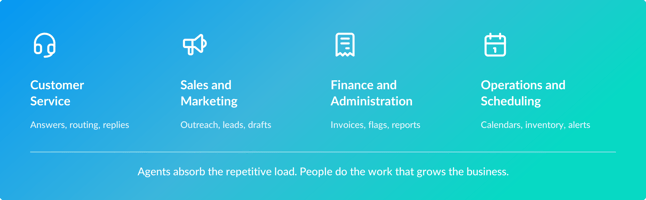
Across every one of these areas, the pattern is the same: agents absorb the repetitive load, and people are freed to do the judgment-driven, relationship-driven work that actually grows the business. For a middle-market company, that reallocation of time is not a convenience—it is a genuine expansion of capacity.
Why Early Adopters Are Winning the AI Race
Every major technology follows a predictable path of adoption—from a small group of innovators and early adopters, through the majority, and finally to the laggards who move only once the shift is unavoidable. Where a business sits on that curve has always shaped its competitive position. With AI, the curve is moving faster than anything before it, and the gap between early adopters and laggards is widening accordingly.
The divide is less about resources than about will. Most organizations already recognize that AI is central to staying competitive; far fewer have moved from recognition to a real plan. The companies pulling ahead are not the largest or best-funded—they are the ones treating adoption as a priority rather than an experiment. For the first time, size is not the deciding factor. Speed is.
The advantage early adopters build is cumulative, not one-time. Teams that start now are not just saving hours today; they are learning which use cases work, building the habits and trust that make the next deployment easier, and compounding those gains month after month. A business that waits two years to begin doesn't start where the early adopter started—it starts two years behind, against a competitor who has already refined what works. You can see this dynamic play out across the full innovation adoption curve: the cost of waiting is rarely visible until the lead is already lost.
Notably, many middle-market companies underestimate how far along their competitors already are. Most are still in early experimentation, using AI for occasional tasks rather than integrating it into how they operate. That leaves a real, and closing, window for the companies willing to move from casual use to intentional adoption.
Partnering With an AI Expert to Compete and Grow
The opportunity is clear, but the path is where middle-market companies most often stumble. The most common mistake is buying tools without a strategy—activating an agent here and a subscription there, with no plan for which problems to solve first, how the pieces fit together, or how to measure whether any of it is working. The result is effort without return, and the quiet conclusion that "AI isn't for us."
That is precisely where AI consulting for the middle market changes the outcome. Rather than experimenting in isolation, a middle-market company working with an experienced partner can quickly identify its highest-impact opportunities, prioritize the right starting point, integrate AI into existing systems, and build the internal confidence needed for lasting adoption. The goal isn't more technology—it's a practical, sequenced plan that turns AI into measurable business results.
At LouderAI, we help middle-market businesses do exactly that: cut through the noise, focus on the use cases that matter, and roll out AI in a way their teams actually embrace. Adoption is rarely blocked by the technology itself—it's the strategy, integration, and change management that make or break the return. If you want a clear-eyed look at the obstacles most teams hit, our guide on overcoming AI implementation challenges is a useful place to start.
The businesses winning with AI aren't the ones spending the most. They're the ones moving with intention—and starting now. If you're ready to put AI agents to work for your team, book a conversation with founder Andrew Louder to explore what an intentional rollout could unlock for your business.

Andrew Louder
CEO & Founder at LouderAI
About the author: Andrew is the Founder & CEO of LouderAI, a Dallas-based consultancy dedicated to helping organizations unlock their full potential through cutting-edge AI solutions.
With nearly two decades in management consulting and a track record advising Fortune 500 clients, he's earned recognition as a Dallas Business Journal 40 Under 40 honoree and Vistage Top Speaker.