

Contents
Somewhere in your organization right now, an AI tool is making a decision no one will be able to explain. It's scoring a lead, flagging an invoice, or drafting a contract, and it's doing it fast. That speed is the point. But speed without structure creates a different kind of risk: models nobody owns, outputs nobody checks, and answers nobody has when a customer, auditor, or regulator asks how the decision got made.
That's the gap AI governance closes.
Strong governance is not a brake on innovation. It's what lets an organization scale AI responsibly and effectively, with the transparency, accountability, and compliance that leadership, customers, and regulators now expect. It's also why so many mid-market companies turn to AI governance consulting services to build the frameworks, policies, and oversight models that make AI trustworthy at scale.
In this article, we break down the best practices for AI governance that every organization should have in place, and the tools that make them stick.
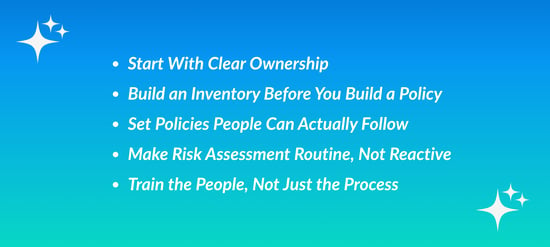
Start With Clear Ownership
The most common governance failure isn't a bad policy. It's no owner. AI gets adopted team by team, tool by tool, and six months later nobody can say who is accountable for what the AI is doing.
Effective AI governance starts with a named structure. That means defining:
- An executive sponsor who owns AI outcomes and risk at the leadership level
- A cross-functional governance group with representation from IT, legal, operations, and the business units using AI
- A clear owner for every AI use case, not just the technology behind it
- Decision rights: who approves a new AI tool, who can expand its scope, and who can shut it down
Ownership turns governance from a document into a practice. When someone is accountable, policies get enforced and problems get surfaced early instead of discovered late.
Build an Inventory Before You Build a Policy
You cannot govern what you cannot see. Most organizations underestimate how much AI is already in use, from formal deployments to the generative tools employees adopted on their own.
Before writing rules, get a complete picture of your AI footprint:
- Every AI tool and model in use, including embedded AI inside existing software
- What data each one touches, especially customer, financial, and employee data
- What decisions or outputs it influences, and whether a human reviews them
- Who uses it, and how often
This inventory becomes the foundation for everything that follows. It tells you where the risk is concentrated, which use cases need tighter controls, and where governance can stay light.
Set Policies People Can Actually Follow
A 40-page AI policy that lives in a shared drive protects no one. The best practices for AI governance favor clear, practical guardrails that employees understand and apply in the moment.
A usable AI policy answers a handful of direct questions:
- Which tools are approved, and which are not
- What data can and cannot be entered into AI systems
- When AI output requires human review before it's used or sent
- How AI-generated content is disclosed to customers or partners
- How to report a concern or a mistake without fear of blame
Keep the policy short, tie it to real workflows, and revisit it quarterly. AI capabilities change fast, and a policy that doesn't evolve with them stops being followed.
Make Risk Assessment Routine, Not Reactive
Not every AI use case carries the same risk. A tool that drafts internal meeting summaries and a model that influences credit or hiring decisions should not be governed the same way.
Tier your AI use cases by risk, then match the oversight to the tier:
- Low risk: internal productivity uses. Light review, standard policy applies.
- Medium risk: customer-facing content or operational decisions with a human in the loop. Documented review process and periodic audits.
- High risk: decisions affecting people's finances, employment, health, or legal standing. Formal approval, bias and accuracy testing, and ongoing monitoring.
Assess new use cases before launch and re-assess existing ones on a schedule. The goal is proportionate control: enough oversight to manage the real exposure, without slowing down the low-risk work that drives most of the value.
Train the People, Not Just the Process
Governance lives or dies on adoption. Employees who understand why the guardrails exist follow them. Employees who see governance as an obstacle route around it.
Build governance literacy across the organization:
- Train every employee on approved tools, data rules, and how to spot a questionable AI output
- Give managers the context to answer questions and reinforce expectations
- Equip your governance group with deeper training on risk assessment and auditing
- Celebrate teams that use AI well and responsibly, not just teams that use it most
When people see governance as a shared standard rather than a compliance chore, it becomes part of how work gets done.
Governance Is What Makes AI Scalable
AI creates real value when it can be trusted. Trust comes from transparency, accountability, and the confidence that when something goes wrong, the organization will know and can respond. Together, these practices let companies expand AI governance tools across the business while keeping risk in check and driving sustainable innovation.
That's where AI governance consulting services make the difference. LouderAI helps mid-market and enterprise teams design the frameworks, policies, and oversight models that turn AI from a collection of experiments into a governed, scalable capability.
If you're ready to scale AI with confidence, book a conversation with founder Andrew Louder to explore what strong AI governance could unlock for your business.

Andrew Louder
CEO & Founder at LouderAI
About the author: Andrew is the Founder & CEO of LouderAI, a Dallas-based consultancy dedicated to helping organizations unlock their full potential through cutting-edge AI solutions.
With nearly two decades in management consulting and a track record advising Fortune 500 clients, he's earned recognition as a Dallas Business Journal 40 Under 40 honoree and Vistage Top Speaker.