

Contents
A manufacturer generates a staggering amount of information every week: sales forecasts, purchase orders, supplier emails, work order histories, quality reports, and a dozen spreadsheets nobody fully trusts. Most of it gets reviewed after the fact, long after the window to act has closed.
The good news is that the capability to close that gap is already within reach. For example, Microsoft 365 Copilot lives inside the apps where work is already happening, and tools like Claude and ChatGPT can connect to internal data through secure integrations, letting teams ask questions across their document libraries instead of digging through each one manually.
In this article, we look at five practical ways AI and manufacturing intersect today, from demand forecasting and supply chain optimization to maintenance planning and production scheduling, with real examples of how AI for manufacturing deliver operational impact.
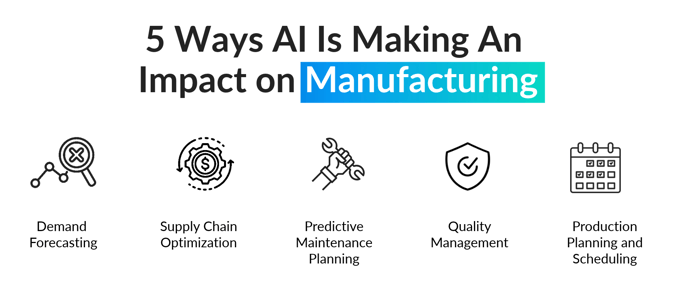
1. Demand Forecasting
Traditional forecasting leans on last year’s numbers and a planner’s intuition. That worked when demand was steady. It breaks when a customer doubles an order, a competitor stocks out, or a season shifts by three weeks. Overestimate and cash sits in inventory. Underestimate and the line idles while sales apologizes.
What this looks like with today’s AI tools:
- Copilot in Excel: Point it at 24 months of sales history and ask, “Which SKUs show the strongest seasonal pattern, and which ones are trending away from last year?” It builds the pivot, charts the trend, and explains the outliers in plain language.
- Claude or ChatGPT: Upload the forecast, the open order report, and the promotions calendar and ask for a list of SKUs where the forecast and the pipeline disagree by more than 15 percent, ranked by revenue at risk.
- Copilot in Teams: After the monthly S&OP meeting, generate a recap of every forecast change that was agreed to, who owns it, and what still needs a decision.
- Any of the three: Draft the forecast commentary for leadership, with the assumptions behind each change called out, in minutes instead of an afternoon.
The outcome is a forecast the business can plan against with confidence, which means less safety stock, fewer expedites, and better on-time delivery.
2. Supply Chain Optimization
Most supply chain disruptions announce themselves early. A supplier’s lead time creeps from 10 days to 14. A carrier starts missing pickup windows. A single-source component sits at a port with no update. The signals are in the emails and the spreadsheets, but nobody connects them until production is waiting on parts.
Can AI optimize the manufacturing supply chain? Yes, and it starts with visibility.
What this looks like with today’s AI tools:
- Copilot in Outlook: Prompt it to summarize every supplier thread from the past week that mentions a delay, a shortage, or a price change, and list the parts affected and the dates promised.
- Copilot in Excel: Load the supplier scorecard and ask which vendors have missed their quoted lead time three or more times this quarter, then chart on-time performance by supplier.
- Claude or ChatGPT: Paste in the open PO report and the current production schedule and ask, “Which open orders put a scheduled job at risk if they arrive five days late, and what are the alternate approved suppliers for those parts?”
- Any of the three: Draft a talking-points sheet for a quarterly business review from the data you already have.
The firms seeing the biggest gains treat AI as an early warning system first and an optimization engine second. Once manufacturing leaders see the problem coming, the fix is easier to make.

3. Predictive Maintenance Planning
Unplanned downtime is expensive. While reactive maintenance waits for the failure, calendar-based maintenance replaces parts that still had life left in them. Neither one uses maintenance history that already lives in the work orders, technician notes, and OEM manuals.
AI solutions in manufacturing for predictive maintenance put that history to work.
What this looks like with today’s AI tools:
- Claude or ChatGPT: Export three years of work orders from the CMMS and ask, “Which assets have the most unplanned repairs, what is the average time between failures, and what was the most common cause listed by the technician?”
- Copilot in Excel: Build a maintenance calendar that lines up recommended preventive tasks with planned downtime windows and highlights the weeks where the workload exceeds the crew’s capacity.
- Copilot in SharePoint: Ask a plain-language question like “What does the OEM manual say about the inspection interval for the hydraulic press?” and get the answer with the source document linked.
- Any of the three: Turn a technician’s brief description of a repair into a complete, consistently formatted work order record.
With AI working from the plant’s own maintenance history, managers go from firefighting to planning. Technicians arrive with the right diagnosis and the right parts, and the plant keeps running through the shift that would have been lost.
4. Quality Management
Most manufacturers have plenty of quality data. Inspection results, nonconformance reports, customer complaints, corrective action records, and supplier certifications all exist. They just live in separate systems, and connecting them takes days of digging every time something goes wrong.
What this looks like with today’s AI tools:
- Claude or ChatGPT: Upload the last six months of nonconformance reports and ask, “Group these by root cause, identify which ones repeat, and flag any that cluster around a specific supplier, material lot, or shift.”
- Copilot in Word: Draft a corrective and preventive action (CAPA) report from the nonconformance record, the investigation notes, and the containment steps already documented.
- Copilot in Outlook: Summarize a customer complaint thread into a one-paragraph issue statement, a timeline, and a list of commitments made, ready to attach to the case file.
- Any of the three “Prepare for an audit by asking for every procedure, certification, and training record tied to a specific process, and flag any with expiration dates that have already passed.”
The result is fewer repeat issues, faster customer responses, and a quality team that spends its time fixing causes instead of assembling reports.
5. Production Planning and Scheduling
The production schedule is often set on Monday and obsolete by Tuesday. A rush order lands, a material shipment slips, a key operator calls out, and the planner rebuilds the plan by hand while everyone waits for direction.
What this looks like with today’s AI tools:
- Copilot in Excel: Load the current schedule, the open orders, and the capacity by line and ask which jobs share a line and week with the rush order, with their due dates and remaining capacity, so the planner can see the conflict before deciding.
- Claude or ChatGPT: Upload the job list with changeover times and due dates and ask for a proposed sequence that reduces changeovers, with the trade-offs called out and any jobs at risk of missing their due date flagged.
- Copilot in Outlook: After a schedule change, draft the update to sales and customer service listing every affected order and its new promise date.
- Any of the three: Build a weekly summary for plant leadership from the schedule and the exception list.
Planners stop reacting and start optimizing. Operations gets a schedule it can trust, and sales gets delivery dates it can promise.

The manufacturers winning right now are not the ones with the most ambitious AI roadmap. They are the ones who picked two or three high-friction workflows, put Copilot, Claude, or ChatGPT to work, measured the hours and dollars saved, and expanded from there.
LouderAI helps manufacturers identify the highest-impact use cases, roll out AI solutions in manufacturing across planning, purchasing, maintenance management, and the front office, and put the training and governance in place to scale with confidence.
If you’re ready to see where AI could have the greatest impact on your operation, book a conversation with founder Andrew Louder.

Andrew Louder
CEO & Founder at LouderAI
About the author: Andrew is the Founder & CEO of LouderAI, a Dallas-based consultancy dedicated to helping organizations unlock their full potential through cutting-edge AI solutions.
With nearly two decades in management consulting and a track record advising Fortune 500 clients, he's earned recognition as a Dallas Business Journal 40 Under 40 honoree and Vistage Top Speaker.